


Wrongful Termination in California: Laws, Settlements and What to Do
- Tom Feher, Esq.

Wrongful termination in California occurs when an employer fires an employee for unlawful reasons, even though the state follows an at-will employment doctrine. Terminations that violate public policy or laws such as the Fair Employment and Housing Act (FEHA) or federal anti-discrimination statutes may give employees the right to pursue legal action. Common examples include firings based on discrimination, retaliation for exercising legal rights, or breaches of employment agreements.
If you believe your termination was illegal, taking action quickly is critical to protecting your rights and preserving evidence.
Speak with our California wrongful termination lawyers today by calling (310) 340-1112 to schedule a free, confidential case evaluation and learn what legal options may be available to you.
Table of Contents
What Is Considered Wrongful Termination in California?
Being fired in California can qualify as wrongful termination if an employer unlawfully dismisses an employee for reasons such as discrimination, retaliation, or violating an employment contract. While most jobs are at-will, employers can fire employees at any time, wrongful termination occurs when these firings violate state or federal employment laws.
California Is an At-Will Employment State — With Important Limits
California generally follows the at-will employment doctrine, meaning employers can terminate employees at any time and for almost any reason. However, at-will employment does not give employers the right to fire workers for unlawful reasons or in ways that violate state or federal employment laws.
Even without a written contract, a termination may be illegal if it is based on discrimination, retaliation for exercising legal rights, or a violation of public policy. Employees who are fired under these circumstances may still have strong grounds for a wrongful termination claim under California law.
Common Types of Wrongful Termination
Wrongful termination can happen for many common unlawful reasons, including discrimination, retaliation, and contract violations. Below are examples of wrongful termination scenarios based on different legal violations.
Discrimination
Wrongful termination based on discrimination occurs when an employer fires an employee due to a protected class under California law, such as:
- Race, color, or national origin: Employers cannot fire employees due to racial bias or cultural background.
- Gender or sexual orientation: Termination based on gender identity, pregnancy, or LGBTQ+ status is illegal.
- Disability or medical condition: Firing an employee due to a physical or mental disability, including pregnancy-related conditions, violates the law.
- Age discrimination: Workers over 40 are protected from wrongful termination due to age-related biases.
- Religious beliefs: Employers cannot fire employees based on religious practices or refusal to participate in religious activities.
Retaliation
Employers cannot terminate workers for exercising their legal rights or reporting misconduct.
- Filing a workplace complaint: Employees are protected when reporting discrimination, harassment, or wage violations.
- Whistleblower retaliation: Employers cannot fire employees for reporting illegal or unsafe workplace activities.
- Requesting medical or family leave: Employers cannot retaliate against employees using protected leave under FMLA or CFRA.
- Refusing to engage in illegal activity: Employees cannot be fired for refusing to break the law at their employer’s request.
- Participating in a workplace investigation: Employees who cooperate in internal or external investigations are protected from termination.
Breach of contract
Some employees have written or implied employment agreements that limit when and how they can be terminated. These agreements may require “good cause” for termination or specific disciplinary steps, and firing an employee in violation of those terms may qualify as wrongful termination under California law.
Employers must also act in good faith when enforcing employment contracts. A termination may be unlawful if an employer engages in unfair or deceptive conduct, such as:
- Firing an employee without the required “good cause.”
- Misrepresenting job security or performance expectations
- Undermining an employee’s ability to succeed
- Ignoring required disciplinary procedures
Even if an employer claims to have followed the contract, bad-faith conduct may still support a wrongful termination claim.
Violating public policy
Employers cannot terminate employees for reasons that violate fundamental public policies. Some of the common examples that our employment attorneys see are:
- Reporting workplace safety violations: Employees who report OSHA violations or unsafe work conditions are protected.
- Exercising voting rights: Employers cannot fire employees for taking time off to vote or serve on a jury.
- Taking legally protected breaks: Denying employees meal breaks or rest periods and retaliating against complaints is illegal.
- Using workers’ compensation benefits: Firing an employee for filing a valid workers’ compensation claim is unlawful.
Constructive discharge
If a workplace becomes unbearable due to employer misconduct, employees may have a wrongful termination case. Our employment law firm sees the following scenarios play out commonly:
- Creating a hostile work environment: Severe harassment or discrimination forcing an employee to quit may qualify as wrongful termination.
- Forcing employees to resign: Employers cannot coerce employees into quitting by making conditions intolerable.
- Cutting hours or benefits drastically: If an employer reduces hours or benefits to push an employee out, it may be considered constructive discharge.
- Targeting employees with unfair discipline: Singling out employees for excessive disciplinary action to drive them to resign is unlawful.
Political Affiliation or Activity
Employers cannot terminate employees for engaging in lawful political activities outside of work, such as:
- Endorsing or supporting political candidates: Employees cannot be fired for their personal political beliefs.
- Engaging in lawful protests or demonstrations: Participation in political activism outside of work is protected.
- Refusing to support an employer’s political agenda: Employers cannot require employees to contribute to or endorse political causes.
Defamation or Damage to Reputation
If an employer wrongfully terminates an employee and spreads false or misleading statements that harm their reputation, it may be grounds for legal action.
- False accusations of misconduct: Employers cannot fabricate allegations to justify termination.
- Negative job references based on retaliation: Providing false information to potential employers may be considered defamation.
- Publicly shaming an employee for protected activity: Announcing false reasons for termination in a way that harms professional reputation may be unlawful.
Military Service Discrimination (USERRA Violations)
The Uniformed Services Employment and Reemployment Rights Act (USERRA) protects employees serving in the military from wrongful termination.
- Firing employees for taking military leave: Employers must reinstate employees after service-related absences.
- Denying promotions or job security due to service obligations: Military personnel cannot be penalized for their service commitments.
While each type of wrongful termination involves different laws and facts, many cases share common patterns. The table below provides a quick reference showing how various wrongful termination claims are evaluated under California law, including the legal protections involved and the early warning signs employees often notice before or after termination.
| Type of Wrongful Termination | Primary Laws Involved | Key Evidence That Matters Most | What Employees Often Notice First |
|---|---|---|---|
| Discrimination | FEHA, Title VII, ADA | Performance reviews, comparisons to coworkers, discriminatory comments, timing | Different treatment compared to coworkers |
| Retaliation | FEHA, Labor Code § 1102.5, FMLA, CFRA | Timeline of complaints, sudden discipline, internal reports | Termination shortly after protected activity |
| Breach of Contract / Bad Faith | Employment agreements, implied contracts | Contract terms, handbook policies, inconsistent enforcement | Employer ignoring promised procedures |
| Violation of Public Policy | Labor Code, case law | Proof of protected conduct (jury duty, workers’ comp, OSHA reports) | Discipline for exercising legal rights |
| Constructive Discharge | FEHA, public policy doctrine | Hostile conditions, HR complaints, lack of correction | Work environment becoming unbearable |
| Political Affiliation or Activity | Labor Code §§ 1101–1102 | Off-duty conduct records, employer communications | Employer reacting to personal beliefs |
| Defamation / Reputation Harm | California defamation law | False statements, references, third-party confirmation | Trouble finding new work after termination |
| Military Service Discrimination | USERRA, CA Military & Veterans Code | Military orders, reinstatement denial, replacement hire | Job issues following military leave |

What to Do If You’re Wrongfully Terminated in California
- Document everything: Keep copies of termination notices, performance reviews, emails, text messages, and the names of any coworkers who witnessed events related to your firing.
- Identify the unlawful reason: Determine whether your termination involved discrimination, retaliation, a breach of contract, or a violation of public policy.
- Consult an employment lawyer promptly: A California wrongful termination attorney can evaluate your situation, explain your rights, and advise you on the strongest legal path forward.
- File the appropriate complaint: Depending on the nature of your claim, you may need to file with the California Civil Rights Department (CRD) or the Equal Employment Opportunity Commission (EEOC) before pursuing a lawsuit.
Acting quickly can be critical, as wrongful termination claims are subject to strict deadlines, and early action helps preserve key evidence.
"I was wrongfully terminated" scenarios
Real-life wrongful termination cases often follow specific patterns. Below are examples of wrongful termination scenarios based on different legal violations.
Discrimination:
Olivia, a 55-year-old marketing executive, had consistently positive performance reviews. After her company hired a younger manager, Olivia noticed she was excluded from meetings and given unrealistic deadlines. Despite meeting expectations, she was fired and replaced with a younger employee. She believes age discrimination played a role.
Retaliation:
Marco reported his supervisor for creating a hostile work environment by making inappropriate racial comments. Two weeks later, he was written up for minor infractions that had never been an issue before. Soon after, he was terminated for “performance concerns,” despite no prior warnings.
Breach of contract:
Stephanie signed a one-year contract as a project manager. After six months, her employer abruptly fired her without cause, even though her contract stated she could only be terminated for failing to meet performance benchmarks. She was given no explanation and denied severance pay outlined in her agreement.
Political affiliation or activity:
Alex, a warehouse worker, attended a peaceful political protest on his day off. A coworker who disagreed with his views reported it to their manager. The next week, Alex was terminated for being “disruptive” at work, despite no history of behavioral issues.
Defamation or damage to reputation:
Sophia was let go after a client accused her of mishandling a major account. Her employer didn’t investigate and falsely claimed she was fired for fraud. When Sophia applied for another job, she discovered her former employer had been telling recruiters she was dishonest, damaging her chances of employment.
Military service discrimination (USERRA violations):
James, a National Guard member, informed his employer that he had to take a two-week leave for military training. When he returned, he was told his position had been eliminated. However, a new employee was hired for the same role days later.
Each of these scenarios represents a potential wrongful termination claim in California. If your situation sounds similar, you may have legal grounds to pursue action against your employer. Call us today for further guidance
Can I sue a company for wrongful termination in California?
Yes, you can sue your employer if your termination was illegal under California law. Wrongful termination claims arise when an employee is fired for reasons that violate discrimination laws, retaliation protections, or contract agreements.
To file a claim, we must prove that your employer’s reason for firing you was unlawful. Employers often disguise wrongful terminations as performance-related or part of company restructuring.
If successful, a wrongful termination lawsuit can provide compensation for lost wages, emotional distress, and other damages. In some cases, punitive damages may also be awarded if the employer’s actions were particularly severe.
California has strict deadlines for filing wrongful termination claims. Taking action quickly ensures we can gather the strongest possible evidence for your case.
If you are weighing whether pursuing a claim makes financial and practical sense, see our complete guide to whether suing your employer in California is worth it.

How can I sue my employer for wrongful termination?
If you believe you were wrongfully terminated, these are the general steps to take legal action against your employer:
- Document everything – Gather emails, termination letters, performance reviews, and any records showing discrimination, retaliation, or contract violations. Keeping a detailed timeline of events helps strengthen your claim.
- Identify the legal basis for your claim – Determine whether your termination was due to discrimination, retaliation, breach of contract, or another illegal reason. Our lawyers will assess your case and identify the strongest legal argument.
- File a complaint with a government agency – If your termination involved discrimination, retaliation, or workplace violations, you may need to file a complaint with the California Civil Rights Department (CRD) or the Equal Employment Opportunity Commission (EEOC). These agencies investigate claims and may attempt to resolve disputes through mediation.
- Obtain authorization to sue – If the agency does not resolve your case, you will need a right-to-sue letter before filing a lawsuit. This document confirms that your administrative claim is complete, allows you to pursue damages in civil court, and is something we can create for you.
- File a wrongful termination lawsuit – With a right-to-sue letter, we can file a lawsuit in civil court. This legal action seeks damages such as lost wages, emotional distress, and potential reinstatement if applicable.
- Negotiate a settlement or go to trial – Many wrongful termination cases settle before trial. If your employer refuses to offer fair compensation, we are prepared to take your case to court and fight for the justice you deserve.
Let our experienced wrongful termination lawyers review your case and provide clear guidance. Call us at (310) 340-1112 or contact us today to schedule your free, personalized case evaluation.
What are wrongful termination settlements in California typically worth?
Wrongful termination settlements in California typically range between $30,000 and $300,000. Higher amounts are possible in cases involving severe employer misconduct.
Compensation depends on factors like lost wages, emotional distress, and punitive damages. Our job is to secure results beyond average wrongful termination settlements, ensuring you receive the compensation you deserve.
For example, we achieved a $1,400,000 settlement for a wrongful termination case in Los Angeles. The final amount depends on the strength of the evidence, the employer’s actions, and the financial losses suffered.
Settlements may include lost wages, future earnings, and emotional distress damages. In cases of extreme wrongdoing, punitive damages may also be awarded.
If you’re wondering what your case might be worth, our wrongful termination settlement calculator provides an estimate based on key factors. While this tool offers a helpful starting point, it can’t replace our legal expertise in assessing case-specific details.
Here is a closer look at what wrongful termination settlements typically look like in California by case type:
| Case Type | Typical Settlement Range |
|---|---|
| Discrimination (race, gender, age, religion) | $50,000 – $300,000 |
| Retaliation for complaint or report | $75,000 – $500,000 |
| Disability discrimination + termination | $75,000 – $400,000 |
| Pregnancy discrimination | $50,000 – $250,000 |
| Whistleblower retaliation | $100,000 to $1,000,000+ |
| Breach of employment contract | $30,000 – $200,000 |
| Constructive discharge | $50,000 – $350,000 |
| FMLA or CFRA retaliation | $50,000 – $300,000 |
| Cases with punitive damages awarded | $200,000 – $2,000,000+ |
These figures represent negotiated settlements, not jury verdicts. Cases that go to trial can result in larger awards but take longer and carry more uncertainty.
Several factors push wrongful termination settlements higher in California:
- Clear documentation of the unlawful reason for termination
- Prior good performance reviews that contradict the stated reason
- A short gap between protected activity (such as a complaint) and the termination
- Evidence the employer has a history of similar conduct
- High lost wages due to a senior role or specialized profession
- Emotional distress that required medical treatment
- Punitive damages where the employer acted with malice or oppression
Under FEHA, if you win your case, your employer must also pay your attorney fees. This makes California wrongful termination cases particularly valuable compared to states without this protection.
Disclaimer: The results generated by this wrongful termination settlement calculator are for general informational purposes only and do not constitute legal advice. This tool provides an estimated calculation based on general inputs and does not account for specific factors, such as the unique details of your case, applicable laws, or liability considerations. The figures provided are not guaranteed and should not be relied upon as a definitive prediction of your settlement outcome.
Reach out to us for more tailored advice for your case — you may be able to claim for more than you think!
How Are Wrongful Termination Settlements Calculated in California?
There is no fixed formula for wrongful termination settlements in California, but attorneys and courts use several consistent factors to arrive at a number.
Lost Wages (Back Pay)
The most concrete component. This is the salary and benefits you lost from the date of termination to the date of settlement or verdict. If you found new work, that income is subtracted from the total.
Future Lost Wages (Front Pay)
If you have not been able to find comparable employment, or if the termination damaged your career trajectory, you may recover future lost earnings as well. This is especially significant for older workers or those in specialized fields.
Emotional Distress Damages
California courts and juries take emotional distress seriously. If you experienced anxiety, depression, loss of sleep, or other documented psychological effects, these are compensable. Medical records and therapy notes strengthen this portion of the claim significantly.
Punitive Damages
Available when the employer acted with malice, fraud, or oppression. California does not cap punitive damages for most wrongful termination claims (unlike federal law, which caps damages at $300,000). This is one of the most powerful tools available to California employees.
Attorney Fees
Under FEHA and several other California statutes, the losing employer pays the winning employee’s attorney fees. This can add six figures to the total recovery and is a major factor in settlement negotiations.
To estimate the value of your specific claim, use our wrongful termination settlement calculator or speak with one of our attorneys in a free consultation.

Wrongful termination laws in California to protect you
California has some of the strongest employment laws in the country, ensuring that workers cannot be fired for unlawful reasons. Wrongful termination laws cover discrimination, retaliation, contract violations, and whistleblower protections, providing legal grounds for employees to take action against unjust dismissals.
Fair Employment and Housing Act (FEHA) – Gov. Code § 12940 prohibits employers from terminating employees based on protected characteristics, including race, gender, age, disability, sexual orientation, and pregnancy. It also protects employees from retaliation if they report discrimination or harassment.
Title VII of the Civil Rights Act of 1964 – 42 U.S.C. § 2000e-3 is a federal law prohibiting wrongful termination based on discrimination, including termination after reporting workplace harassment. Employers with 15 or more employees are covered, ensuring protection for workers facing retaliation for reporting unlawful behavior.
California Labor Code § 1102.5 – Labor Code § 1102.5 protects whistleblowers from termination for reporting legal violations, including unsafe working conditions, wage theft, and employer misconduct. Employees who report illegal activities internally or to government agencies are protected from retaliation.
Sexual Harassment and Retaliation Protections – Gov. Code § 12940(j) states employees cannot be fired for reporting sexual harassment, filing a complaint with HR, or participating in a workplace investigation. If an employer retaliates by demoting, firing, or creating a hostile work environment, the employee may have a wrongful termination claim under FEHA and Title VII.
Labor Code Section 230 – Labor Code § 230 ensures employees cannot be terminated or retaliated against for taking time off for jury duty, appearing in court, or seeking legal protection as victims of domestic violence, sexual assault, or stalking. Employers are required to make reasonable accommodations for victims, such as modifying work schedules or allowing leave to seek medical or legal assistance.
Family and Medical Leave Act (FMLA) & California Family Rights Act (CFRA) – Gov. Code § 12945.2 protects employees from termination for taking family or medical leave, caring for a sick relative, or taking pregnancy leave. Employers must reinstate employees returning from leave and cannot fire them for using their protected time off.
California Military and Veterans Code § 394 – Mil. & Vet. Code § 394 states employees cannot fire or discriminate against employees for military service obligations, including National Guard or Reserve duties. Termination due to military leave violations may be pursued under USERRA or California state law.
If you believe your termination violated any of these laws, you may have a strong claim for wrongful termination. Reach out to our experienced employment lawyers today to protect your rights and fight for the justice you deserve.
Wrongful Termination Statute of Limitations in California
Missing a filing deadline in a wrongful termination case typically ends your claim entirely, regardless of how strong it is. California has different deadlines depending on which law you are filing under.
| Claim Type | Filing Deadline |
|---|---|
| FEHA complaint (CRD) | 3 years from date of termination |
| EEOC complaint (federal) | 300 days from date of termination |
| Civil lawsuit after CRD right to sue | 1 year from right-to-sue letter |
| Civil lawsuit after EEOC right to sue | 90 days from right-to-sue letter |
| Breach of written contract | 4 years from date of termination |
| Breach of oral contract | 2 years from date of termination |
| Whistleblower retaliation (Lab. Code) | 3 years from retaliatory act |
Key things to know about these deadlines:
- The 3-year FEHA deadline applies to most discrimination and retaliation claims and was expanded from 1 year by AB 9 in 2020.
- The EEOC’s 300-day deadline is strict. If you are considering a federal claim, this clock starts the day your termination is effective.
- After you receive a right-to-sue letter from the CRD, you have 1 year to file a civil lawsuit. After an EEOC right-to-sue letter, you have only 90 days.
- If your termination involved a written employment contract, you have 4 years to sue for breach, but other claims (like discrimination) still follow the shorter deadlines above.
When in doubt, consult an attorney as early as possible. Evidence disappears, witnesses’ memories fade, and missing a single deadline can bar your claim forever.

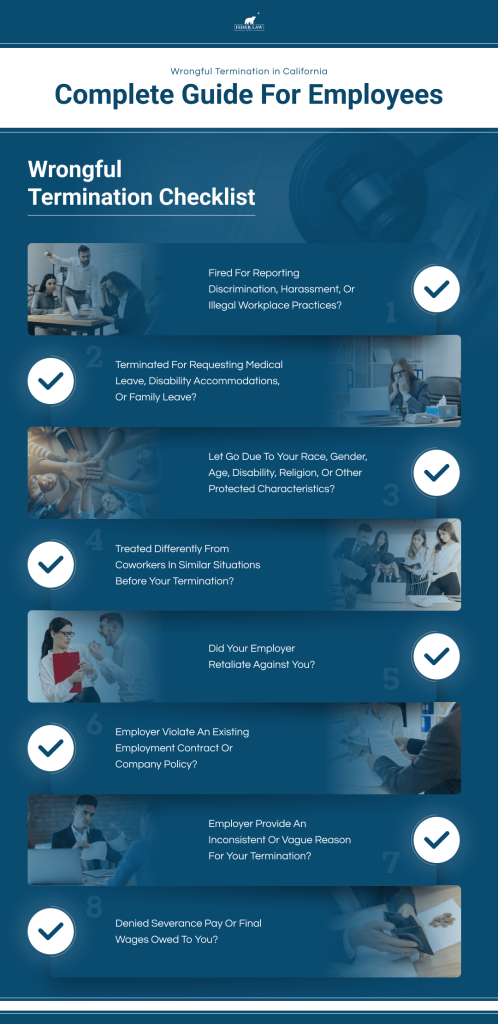
Wrongful termination checklist
If you suspect you have been wrongfully terminated, ask yourself the following questions:
- Were you fired for reporting discrimination, harassment, or illegal workplace practices?
- Were you terminated for requesting medical leave, disability accommodations, or family leave?
- Were you let go due to your race, gender, age, disability, religion, or other protected characteristics?
- Were you treated differently from coworkers in similar situations before your termination?
- Did your employer retaliate against you after filing a complaint or whistleblowing?
- Did your employer violate an existing employment contract or company policy when firing you?
- Did your employer provide an inconsistent or vague reason for your termination?
- Were you denied severance pay or final wages owed to you under California law?
If you answered “yes” to any of these questions, you may have a wrongful termination case. Speak with our Huntington Beach wrongful termination lawyer to evaluate your legal options today.
Have you suffered from an unfair termination of employment? Reach out to Feher Law today!
Losing your job unfairly can have serious financial and emotional consequences, but you don’t have to face it alone. At Feher Law, our attorneys fight for employees who have been wrongfully terminated, ensuring they receive the justice and compensation they deserve.
Our experienced legal team will assess your case, gather the necessary evidence, and take on your employer to hold them accountable. Whether through settlement negotiations or litigation, we are prepared to pursue the best possible outcome for you.
Don’t let your employer’s actions go unchallenged. Call us at (310) 340-1112 or contact us today to schedule your personalized free case evaluation.

Common misconceptions about wrongful termination in California
“California is an at-will state, so my employer can fire me for any reason.”
While California employment is generally at-will, employers must still follow state and federal labor laws and cannot terminate employees for unlawful reasons such as discrimination, retaliation, or violations of public policy.
“My employer said it was a performance issue, so I don’t have a case.”
Employers often rely on performance claims to mask illegal motives, and terminations that closely follow protected activity may still support a lawsuit for wrongful termination.
“I don’t have a written contract, so I have no legal protection.”
Even without a formal agreement, employees may be protected by implied contracts, workplace policies, and California labor laws that restrict unfair or unlawful firings.
“I already accepted severance, so I can’t take legal action.”
Accepting severance does not always prevent employees from pursuing legal options, especially if the agreement was signed without a full consultation or under pressure.
“If I quit, I can’t file a wrongful termination claim.”
Employees who are forced to resign due to intolerable working conditions may still pursue a lawsuit for wrongful termination under the theory of constructive discharge.
Key takeaways for wrongful termination cases in California
- At-will employment does not mean unlimited employer power. Terminations based on discrimination, retaliation, breach of contract, or violations of public policy may still be illegal under California labor laws.
- Employer explanations are not always the full story. Performance-related justifications, severance offers, or forced resignations do not automatically eliminate your right to pursue a wrongful termination claim.
- Strong evidence makes a difference. Preserving documents, timelines, and witness information can significantly strengthen your case and help uncover unlawful motives.
- Compensation can be substantial. Wrongful termination settlements often range from $30,000 to $300,000, with higher recoveries possible in cases involving serious employer misconduct.
- Timing is critical. California imposes strict deadlines for filing claims, and delays can permanently limit your legal options.
If you believe your termination may have violated California law, don’t assume you’re out of options. Speak with our Torrance wrongful termination lawyer today to get clear answers about your rights and next steps.
Call (310) 340-1112 now to schedule your free, confidential consultation and find out whether you have a case worth pursuing.
FAQs
Yes, California is an at-will employment state, meaning employers can terminate employees without cause. However, they cannot fire you for illegal reasons like discrimination, retaliation, or contract violations. If you suspect wrongful termination, our legal team can evaluate your case and protect your rights.
In some cases, reinstatement is possible, but most wrongful termination claims result in financial compensation instead. Settlements often include lost wages, emotional distress, and punitive damages. Our legal team fights for the best outcome, whether that means job reinstatement or maximizing your compensation.
Employers often use performance issues as a pretext to justify wrongful termination. If your termination followed a complaint or involved sudden negative reviews, you may have a strong case. We analyze performance records, witness testimony, and employer actions to uncover retaliation or discrimination.
Before accepting a severance package, review the terms carefully to ensure you’re not waiving your right to pursue legal action. Employers may offer low settlements to avoid a wrongful termination lawsuit. Our legal team can evaluate your severance offer and negotiate a better outcome if necessary.
The wrongful termination statute of limitations in California varies depending on the type of claim. For discrimination or retaliation, you typically have three years to file with the California Civil Rights Department. Other claims may have different deadlines, so contacting a lawyer as soon as possible is vital.