California Restaurant Slip and Fall Lawsuit: Premises Liability Guide (2026)
- Tom Feher, Esq.
By Thomas Feher, Esq. | Founder, Feher Law APC | California Bar (2011) | Verified Author
If you slipped and fell at a California restaurant, you can sue under California premises liability law (Civil Code §1714) when the restaurant knew or should have known about a dangerous condition and failed to fix it. Average California restaurant slip and fall settlements range from $15,000 for minor injuries to $500,000+ for severe injuries requiring surgery. Restaurants face higher liability than most businesses because wet floors, dropped food, grease, and bathroom hazards are foreseeable parts of daily operation. Feher Law has secured a $5,000,000 slip and fall verdict and a $3,600,000 verdict in Jose Trinidad Flores v. M & N Rug Enterprise, LLC for California clients hurt on negligently maintained property.
“The single biggest mistake restaurant slip and fall victims make is leaving without filing an incident report. I’ve seen valid cases get killed because the restaurant later claimed the fall never happened. If you fell at a restaurant in California, ask the manager for a written incident report before you walk out. Take photos. Get the names of two employees who saw the spill. Those three steps double the value of most cases.”
– Thomas Feher, Esq., Founder of Feher Law APC | California Bar (2011) | Super Lawyers 2022-2026 | Avvo Rating 10.0
Key Takeaways
- Statute: California Civil Code §1714 holds property owners, including restaurants, liable for injuries caused by a dangerous condition they knew or should have known about.
- Settlement range: California restaurant slip and fall settlements typically run $15,000 for minor injuries to $500,000+ for severe injuries requiring surgery, with catastrophic cases exceeding $1,000,000.
- Notice rule: You must prove the restaurant had actual or constructive notice of the hazard. A spill that sat on the floor for 20 minutes during a busy dinner service almost always meets the standard.
- Filing deadline: Code of Civil Procedure §335.1 gives you 2 years from the date of the fall to file a lawsuit in California.
- Feher Law recovered $3,600,000 in Jose Trinidad Flores v. M & N Rug Enterprise, LLC for a California slip and fall client. We handle every restaurant slip and fall case on contingency. You pay nothing unless we win.
Free Case Evaluation – No Fee Unless You Win
If you slipped and fell at a California restaurant, Feher Law can recover compensation for your medical bills, lost wages, and pain and suffering.
Call (424) 622-3350 or visit our California premises liability law firm page for a free consultation.
California Restaurant Slip and Fall Settlement Amounts (2026)
Settlement values vary widely based on injury severity, length of medical treatment, and whether the restaurant has a documented history of similar incidents. The table below reflects typical California restaurant slip and fall ranges based on injury type.
| Injury Type | Typical Settlement Range | High-Value Cases |
|---|---|---|
| Minor bruising or sprain (full recovery) | $5,000 – $25,000 | $40,000+ |
| Soft tissue injury with physical therapy | $15,000 – $75,000 | $150,000+ |
| Broken arm, wrist, or ankle | $50,000 – $200,000 | $400,000+ |
| Broken hip (often elderly diners) | $150,000 – $500,000 | $1,000,000+ |
| Herniated disc requiring surgery | $200,000 – $750,000 | $1,500,000+ |
| Traumatic brain injury or concussion | $250,000 – $1,000,000 | $5,000,000+ |
| Spinal cord injury or paralysis | $1,000,000+ | $10,000,000+ |
How California Premises Liability Law Applies to Restaurant Slip and Falls
California restaurants are legally required to keep their floors, bathrooms, parking lots, and entryways reasonably safe for customers. Civil Code §1714 imposes a duty of care on every property owner, and California courts have consistently held that restaurants face one of the higher standards because spills, dropped food, and wet bathroom floors are predictable hazards of food service. To win a restaurant slip and fall case, you must prove the restaurant either created the dangerous condition, knew about it and failed to fix it, or should have known about it through reasonable inspection. The legal term is “constructive notice,” and California juries will find a restaurant liable if a hazard existed long enough that a reasonable inspection schedule would have caught it. A puddle of soda that sat on the floor for 30 minutes during a Friday dinner rush almost always satisfies the constructive notice standard. A spill that happened 30 seconds before the fall typically does not. The age, condition, and maintenance history of the restaurant matter heavily. Older buildings with worn tile, broken handrails, or chronic leaks face higher liability exposure.
What “Reasonable Inspection” Means in California Restaurants
California case law expects restaurants to inspect their dining floors every 15 to 30 minutes during service, with bathroom checks at least hourly. Failure to maintain inspection logs is itself evidence of negligence. In discovery, Feher Law routinely requests the restaurant’s sweep logs, employee schedules, and security footage covering the 60 minutes before the fall. Missing or destroyed records create a presumption of negligence under California’s spoliation doctrine, which often forces a settlement before trial.
Common Restaurant Slip and Fall Hazards: Wet Floors, Spilled Food, Greasy Surfaces
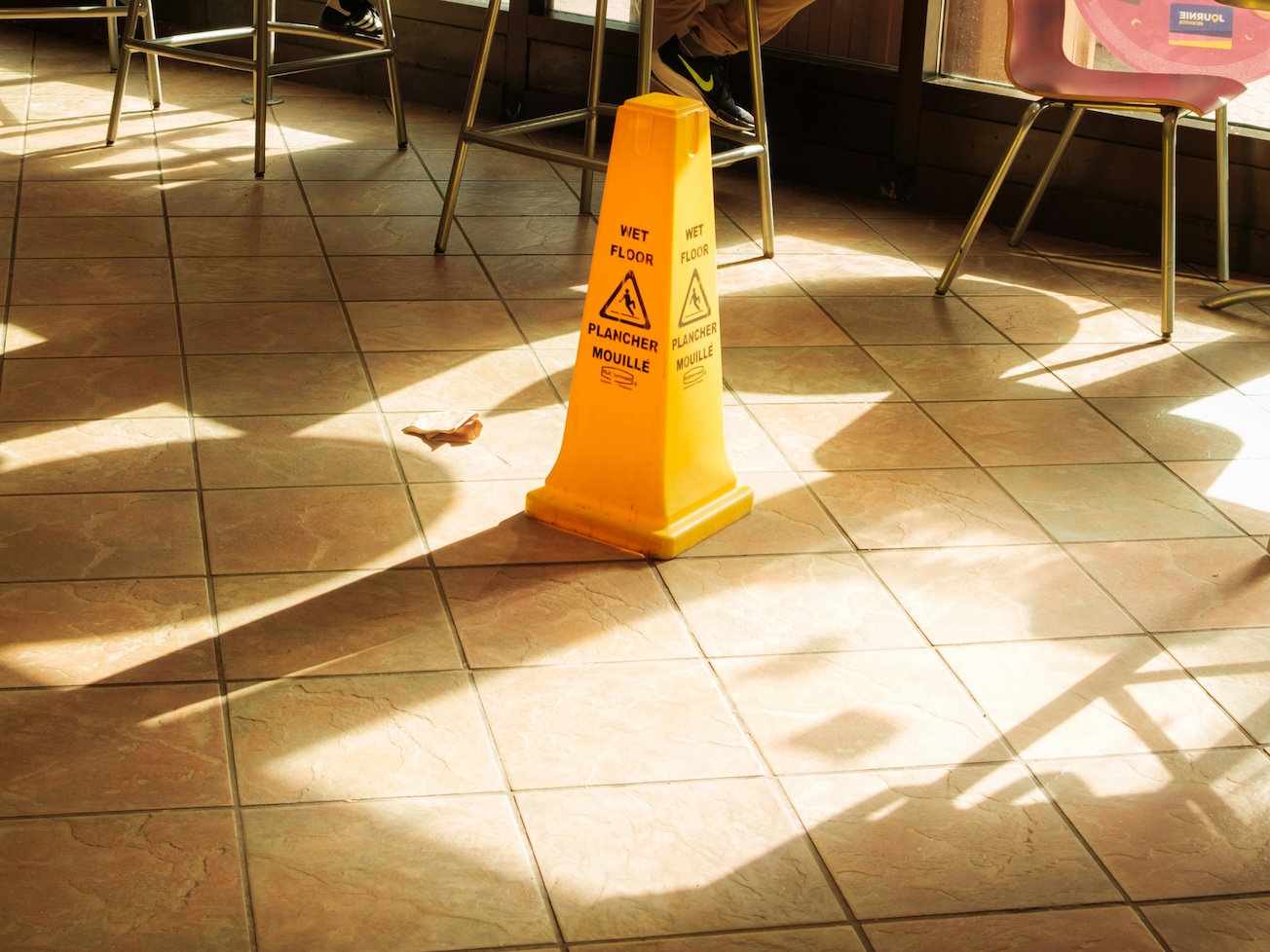
The most common restaurant slip and fall hazards in California are wet floors from spilled drinks, grease tracked from the kitchen to the dining room, water pooling near soda fountains and ice stations, and unmarked freshly mopped floors. Restaurant bathrooms are the second-highest hazard zone because of water on tile, leaking sinks, and hand-dryer drip. Parking lots and sidewalks immediately outside the entrance also generate liability claims, especially when grease from kitchen exhaust drips onto walkways or when restaurants fail to salt and clear in colder regions. California’s outdoor dining boom has added new hazard categories: uneven temporary platforms, exposed cords, parklet steps without contrast strips, and missing handrails on raised seating. Each of these scenarios has produced six-figure California verdicts in the last five years. The hazards that generate the highest settlements are those where the restaurant created the danger directly, like a server who dropped a tray and continued working without cleaning the spill, or where the restaurant ignored a known recurring problem like a chronically leaking ice machine. Documenting the source of the hazard with photos and witness statements before leaving the scene is the single most important thing you can do to protect a future claim.
Talk to a California Premises Liability Attorney
Feher Law has recovered over $170 million for clients across Southern California.
What to Do After a Slip and Fall at a California Restaurant
The five steps you take in the first 30 minutes after a restaurant slip and fall determine 80% of your case value. California courts and insurers heavily weight contemporaneous evidence, and most cases that fail do so because the victim left without preserving the scene. Follow these steps in order, even if you are embarrassed or feel only mildly hurt.
- Get medical care immediately. Call 911 or have someone drive you to the ER. Many serious injuries including concussions, herniated discs, and hip fractures do not produce full pain for 24 to 72 hours. A same-day medical record is the strongest evidence linking your injury to the fall.
- Ask the manager for a written incident report. Get a copy or photograph it. If the manager refuses, write down their name, the time, and exactly what they said. Restaurants are required to document customer injuries, and missing reports become evidence of negligence.
- Photograph everything. Take photos of the hazard, the surrounding floor, any warning signs (or absence of them), your shoes, your injuries, and the lighting. Wide shots and close-ups. Photograph the area from multiple angles before anything is cleaned up.
- Get witness contact info. Names, phone numbers, and email addresses of anyone who saw the fall or the hazard before the fall. Other diners often provide more credible testimony than restaurant employees.
- Call a California restaurant slip and fall lawyer before the insurance company calls you. Restaurant insurers move fast to take recorded statements that lock in low-value narratives. Feher Law handles every case on contingency. You pay nothing unless we win.
How Long Do You Have to Sue a Restaurant for a Slip and Fall in California
You have 2 years from the date of the fall to file a personal injury lawsuit against a California restaurant under Code of Civil Procedure §335.1. Missing this deadline ends the case permanently regardless of how strong the underlying liability is. The clock starts the day of the fall, not the day you discovered the full extent of your injuries, with limited exceptions for delayed-discovery cases like undiagnosed brain injuries. If the restaurant is operated by a government entity (Government Code 911.2 six-month claim; Government Code 835 dangerous-condition standard), like a cafeteria inside a public building or a concessionaire on city property, the deadline drops to 6 months and you must first file an administrative claim before any lawsuit. Out-of-state diners injured at California restaurants still file under California law because the injury occurred in California. Insurance claim deadlines are separate and shorter. Most restaurant general liability policies require notice within 30 to 90 days, which is why calling a lawyer in the first week after the fall protects every deadline at once.
Why You Need a California Restaurant Slip and Fall Lawyer
Restaurant slip and fall cases are won or lost in discovery, and discovery requires a lawyer who knows what to demand from a restaurant chain’s defense counsel. The most valuable evidence in a restaurant case is almost never given voluntarily. Sweep logs, employee schedules, prior incident reports involving the same hazard, security camera footage from before and after the fall, and the restaurant’s internal safety manual all sit behind a defense team that will object to every request. Self-represented plaintiffs almost always settle for 30 to 50% less than represented plaintiffs because they lack access to those documents. Feher Law has the trial track record to push restaurant insurers off lowball offers, including a $5,000,000 slip and fall verdict and the $3,600,000 verdict in Flores v. M & N Rug Enterprise. We also know how to handle the recurring restaurant defenses: the “open and obvious” hazard argument, the comparative negligence argument that you should have seen the spill, and the lack-of-notice argument when sweep logs are missing or doctored. You pay nothing unless we win.
You Pay Nothing Unless We Win
Our California premises liability attorneys work on contingency, no upfront fees.
See how slip and fall settlements are calculated. Call (424) 622-3350 for a free, confidential case review.
What to Expect When You Work With Feher Law
- Free Case Evaluation: Call (424) 622-3350 or schedule online. We review the fall, the injuries, the medical care to date, and any photos or incident reports you have. There is no fee, no obligation, and no pressure to retain.
- Case Investigation: Our team sends a litigation hold letter to the restaurant within 48 hours to preserve security footage, sweep logs, and employee statements. We obtain medical records, get prior incident reports for the same location, and reconstruct the timeline of the fall.
- Filing Your Claim: We file a demand letter on the restaurant’s general liability insurer, or a lawsuit if the insurer refuses to negotiate in good faith. California’s 2-year statute of limitations under §335.1 sets the hard deadline, and we protect it from day one.
- Negotiation and Mediation: Most California restaurant cases settle in mediation after discovery is complete. We use the sweep logs, prior incidents, and witness depositions to push the insurer above their initial reserve. Typical case timeline runs 12 to 24 months from filing to resolution.
- Resolution: When we settle or win at trial, the funds clear our trust account, medical liens are negotiated down, and the net is wired to you. Our contingency fee is taken from the recovery. You pay nothing unless we win.
Why California Restaurant Slip and Fall Clients Choose Feher Law
Thomas Feher, Esq. has tried more than 50 California personal injury cases to verdict, including the $3,600,000 Flores v. M & N Rug Enterprise slip and fall verdict and the $5,000,000 slip and fall recovery. Feher Law APC has secured over $170 million for California clients across personal injury, premises liability, and employment cases. With offices in Huntington Beach and Torrance, the firm serves restaurant slip and fall victims throughout Los Angeles County, Orange County, San Bernardino County, and Riverside County. Restaurant cases require litigation experience that most personal injury firms lack. Major restaurant chains hire defense firms that specialize in killing premises liability claims, and self-represented plaintiffs or under-resourced firms almost always settle for less than the case is worth. Feher Law takes restaurant cases that other firms decline because of disputed notice or “open and obvious” defenses. Every restaurant slip and fall case is handled on contingency. You pay nothing unless Feher Law wins for you.
Frequently Asked Questions
Most California restaurant slip and fall cases settle between $15,000 and $500,000, measured under Civil Code 3333 as all the detriment proximately caused, depending on injury severity. Severe cases involving broken hips, herniated discs requiring surgery, or traumatic brain injuries often exceed $1,000,000. The biggest variables are medical bills, length of treatment, lost income, and whether the restaurant has a documented history of similar incidents. Feher Law recovered $5,000,000 in a California slip and fall case for a client with severe injuries.
You can still file a California restaurant slip and fall claim without an incident report, but the case becomes harder. The restaurant will likely argue the fall never happened or that it was minor. You will need to rely on medical records, witness statements, credit card receipts proving you were at the restaurant, and any photos taken at the scene. Call a lawyer immediately to send a litigation hold preserving security footage before the restaurant overwrites it, typically within 30 to 90 days.
Yes, but the case is harder, and any share of fault assigned to you reduces recovery under Civil Code 1431.2 rather than barring it. California restaurants can use the open and obvious defense if they posted a clear warning sign in the right location, but the defense fails when the sign was placed after the fall, was hidden behind furniture, or was insufficient given the size of the hazard. A small wet floor sign 10 feet away from a large grease spill is not adequate notice under California law. Comparative fault may reduce your recovery percentage, but it rarely eliminates the case.
Most California restaurant slip and fall cases resolve in 12 to 24 months from filing. Cases that settle pre-litigation through demand letters can wrap in 4 to 8 months. Cases that go to trial run 24 to 36 months because of California's crowded court calendars. The Code of Civil Procedure §335.1 statute of limitations is 2 years, so the lawsuit must be filed within that window even if negotiations are ongoing.
For minor injuries with under $5,000 in medical bills and full recovery, you can often handle the claim yourself. For anything more serious, a lawyer typically nets you 2 to 3 times more even after the contingency fee. Restaurant insurers settle low when they sense an unrepresented plaintiff. Feher Law offers free consultations so you can evaluate the case before deciding. See should I get a lawyer for a slip and fall for a deeper look.
Broken arm and wrist injuries from California restaurant slip and falls typically settle between $50,000 and $200,000, with cases requiring surgical pinning, plates, or screws often exceeding $400,000. The settlement value rises if the fracture caused permanent loss of grip strength, range of motion, or interfered with your ability to work. See our average settlement for a broken arm in a slip and fall breakdown for case examples.
National restaurant chains have larger insurance policies and deeper litigation budgets, which usually means higher settlement potential but a tougher fight. Chains like Olive Garden, Applebee's, Chipotle, and Starbucks have national defense counsel networks that fight every claim aggressively. Settlement amounts are typically 25 to 50% higher against chains than against independent restaurants for the same injury, but the case timeline is longer because of the corporate defense apparatus.
Ready to Talk to a California Restaurant Slip and Fall Lawyer?
Feher Law offers free, confidential consultations, no upfront fees.
Call (424) 622-3350 or visit our Huntington Beach slip and fall lawyer page to get started today.
Last reviewed by Thomas Feher, Esq. – September 2026