
Emotional Distress Lawsuit in California: Complete Guide (2026)
- Tom Feher, Esq.

By Thomas Feher, Esq.|Founder, Feher Law APC|50+ jury trials|$170M+ recovered|Super Lawyers 2022-2026|Avvo 10.0
An emotional distress lawsuit in California is almost always pursued as part of an underlying personal injury or employment case, not as a freestanding claim for ordinary upset. It can be brought as either negligent infliction of emotional distress (NIED, generally requiring physical injury or bystander witnessing) or intentional infliction of emotional distress (IIED, requiring extreme and outrageous conduct). Stand-alone IIED claims with no underlying tort typically settle between $25,000 and $200,000, while emotional distress damages attached to a PI, harassment, or wrongful termination case frequently add $50,000 to $500,000. CCP 335.1 (two years) governs NIED, and CCP 335.1 also typically applies to IIED. Therapy records and consistent documented symptoms are the strongest evidence. This guide explains both claim types, and how each ties back to a personal injury accident or a workplace violation, in detail.
If your emotional distress stems from an accident, injury, or workplace claim, our personal injury lawyer in Torrance is available today for a free consultation to help you seek the compensation you deserve.
Key Takeaways
- California law allows victims to sue for emotional distress even without physical injuries, covering conditions like PTSD, anxiety, depression, and panic attacks caused by another party’s negligence or intentional misconduct.
- Emotional distress claims fall into two categories – negligent infliction (NIED), where someone acted carelessly, and intentional infliction (IIED), where the conduct was extreme and outrageous.
- California does not cap emotional distress damages in most personal injury cases. Compensation is typically calculated at 1.5x to 10x your economic damages depending on the severity of your condition.
- You generally have two years from the date of the incident to file an emotional distress lawsuit in California under Code of Civil Procedure §335.1. Missing this deadline forfeits your right to recover.
- Feher Law has recovered $170M+ for California clients, including a $4 million verdict for a client with PTSD after an auto crash. Call for a free consultation – you pay nothing unless we win.
Do You Have a Valid Emotional Distress Claim? Read This First
Emotional distress on its own is not a lawsuit. In California, you cannot sue simply because an event upset you, stressed you out, or made you anxious. Emotional distress is compensable only when it is tied to an underlying legal wrong, and in nearly every case that wrong is either a personal injury or an employment violation committed by someone who is legally responsible.
You likely have a valid claim if your emotional distress comes from:
- A personal injury accident. A car crash, a serious injury, or another incident caused by someone else’s negligence, usually pursued alongside a California personal injury claim.
- Witnessing harm to a close family member. Seeing a spouse, child, or parent seriously injured or killed by someone’s negligence (California’s “bystander” rule).
- Workplace misconduct. Harassment, discrimination, retaliation, or wrongful termination, pursued as part of a California employment claim.
- Extreme and outrageous intentional conduct that goes beyond all bounds of decency, the legal standard for intentional infliction of emotional distress.
You likely do not have a claim if your distress comes from:
- Ordinary life stress, grief, a breakup, or a personal disagreement with no underlying legal wrong.
- Rude, insulting, or inconsiderate behavior that is not “extreme and outrageous” under the law.
- An upsetting situation where no specific person or company is legally at fault for causing it.
If your emotional distress is connected to a personal injury or to something that happened at work, we want to hear from you. If it is not tied to either, an emotional distress lawsuit is unlikely to succeed, and we will tell you that honestly in your free consultation rather than waste your time.

What is emotional distress in law?
In California, emotional distress refers to mental suffering that results from another person’s negligence in an accident or injury, or from unlawful conduct at work such as harassment, discrimination, retaliation, or wrongful termination. It is not a standalone harm you sue for in isolation. Getting to know emotional distress in a legal context is essential when pursuing compensation as part of a personal injury or employment lawsuit. California courts recognize emotional distress as a compensable harm even without physical injuries in specific circumstances.
📌 According to the California Civil Jury Instructions (CACI), emotional distress damages can be recovered as a component of pain and suffering from a car accident in personal injury cases, and as part of the harm caused by an employer’s unlawful conduct. The state’s approach is more progressive than many others that require physical injury to accompany mental anguish claims.
| Legal Element | Negligent Infliction (NIED) | Intentional Infliction (IIED) |
|---|---|---|
| Intent Required | No | Yes – extreme and outrageous conduct |
| Example | Witnessing a family member’s fatal accident | Persistent workplace harassment |
| Physical Harm Needed? | Sometimes | No |
| Evidence Required | Objective medical proof preferred | Must show severe distress and intent |
| Typical Complexity | Lower bar for filing | Higher threshold for success |
Is emotional distress a personal injury?
Yes, emotional distress in California is considered a personal injury under state law. The legal system recognizes that psychological injuries can be just as debilitating as physical ones. When pursuing a personal injury claim, you can include emotional distress as a significant component of your damages.
In the employment context, emotional distress is pursued under the Fair Employment and Housing Act (FEHA) as part of a harassment, discrimination, retaliation, or wrongful termination claim, rather than as a separate suit. The distress is treated as harm caused by the employer’s unlawful conduct.
Mental health conditions resulting from traumatic events, such as anxiety disorders, depression, post-traumatic stress disorder (PTSD), or insomnia, qualify as legitimate injuries. These conditions often have measurable impacts on daily functioning and quality of life.
✔️ Someone experiencing debilitating panic attacks after witnessing a horrific car accident may have a valid claim, even without personally suffering physical injuries. California courts have established precedent for compensation in such cases through the “bystander” theory of recovery.
The intangible nature of emotional distress makes these claims challenging, but not impossible. Our experienced personal injury and employment lawyers will help gather the necessary evidence to strengthen your claim and demonstrate the severity of your emotional distress to insurance companies or a jury.
Punitive Damages for Emotional Distress in California (Civil Code 3294)
When emotional distress results from especially egregious conduct, California allows punitive damages under Civil Code 3294, which punish the wrongdoer rather than compensate the victim. To recover them you must prove by clear and convincing evidence that the defendant acted with malice, oppression, or fraud. Punitive damages are available on top of your compensatory emotional-distress recovery and can substantially increase the total, which is why documenting the defendant’s intent and conduct matters so much in these cases.
Loss of Consortium: Emotional Harm to a Spouse
When a serious injury harms a marriage, California recognizes a separate claim called loss of consortium, which allows the uninjured spouse to recover for the loss of companionship, affection, and support caused by the injury. It is a distinct claim belonging to the spouse, not the injured person, and it is valued based on the strength of the relationship and the severity of the injury’s impact on married life. Loss of consortium is one way California law compensates the ripple effects of a serious injury beyond the injured person alone.
Is There an Average Settlement for Emotional Distress in California?
There is no fixed average, because emotional-distress damages depend heavily on severity and documentation, but California claims commonly range from $25,000 to $250,000 or more when the distress is well documented and tied to serious misconduct or injury. California places no statutory cap on emotional-distress damages in ordinary cases, so severe, professionally documented distress can settle well above that range. The key is a treatment record: distress supported by a therapist or physician carries real value, while undocumented distress carries little.
Can you sue someone for emotional damage?
Yes, in California, you can sue for emotional damage, but only when it is tied to an underlying legal wrong, not for ordinary interpersonal upset. There are two main paths: (a) negligence in a personal injury accident, such as a car crash or other incident caused by someone else’s carelessness, and (b) intentional or unlawful conduct in an employment setting, such as harassment, discrimination, retaliation, or wrongful termination by an employer.
To recover, you will need to demonstrate that the other party either intentionally caused you harm or acted with negligence, and that your distress flows from that underlying wrong. The severity of emotional distress required varies between intentional and negligent cases.
💡 Don’t assume physical injuries are necessary – California law recognizes the severe impact of purely psychological trauma in certain situations, particularly in intentional infliction of emotional distress cases where extreme emotional distress is the expected outcome of outrageous conduct.
Emotional harm from negligent actions must typically be severe and manifested through physical symptoms or documented mental health treatment. Courts examine factors including the intensity and duration of distress, any associated physical symptoms, and underlying psychological conditions.
How can you sue someone for emotional distress?
Pursuing emotional distress damages happens within a personal injury or employment claim, and requires careful preparation and knowledge of legal requirements. The process involves several critical steps to ensure your claim meets California’s standards for compensation.
- Identify the underlying wrong: determine whether your distress arises from a personal injury accident or from an employment violation such as harassment, discrimination, retaliation, or wrongful termination.
- Determine whether the case involves negligent infliction of emotional distress or intentional infliction of emotional distress to establish the appropriate legal standard.
- Tie your distress to that underlying wrong, and gather comprehensive medical and therapy documentation that validates your emotional suffering and connects it to the incident or workplace conduct.
- Identify all potentially responsible parties, whether an at-fault driver, a property owner, or an employer, who contributed to your emotional distress through their actions or negligence.
- File within California’s deadline for your type of claim, the personal injury statute of limitations for PI-based distress or the FEHA administrative deadline for employment-based distress, then consult with our qualified attorney to evaluate your claim.
The stronger your documentation and expert testimony, the more likely your emotional distress claim will succeed in settlement negotiations or at trial.
Examples of emotional distress damages
Emotional distress damages compensate for psychological suffering caused by a personal injury or by unlawful conduct at work. These non-economic damages are intangible but very real consequences that can significantly impact a person’s life.
Common examples include:
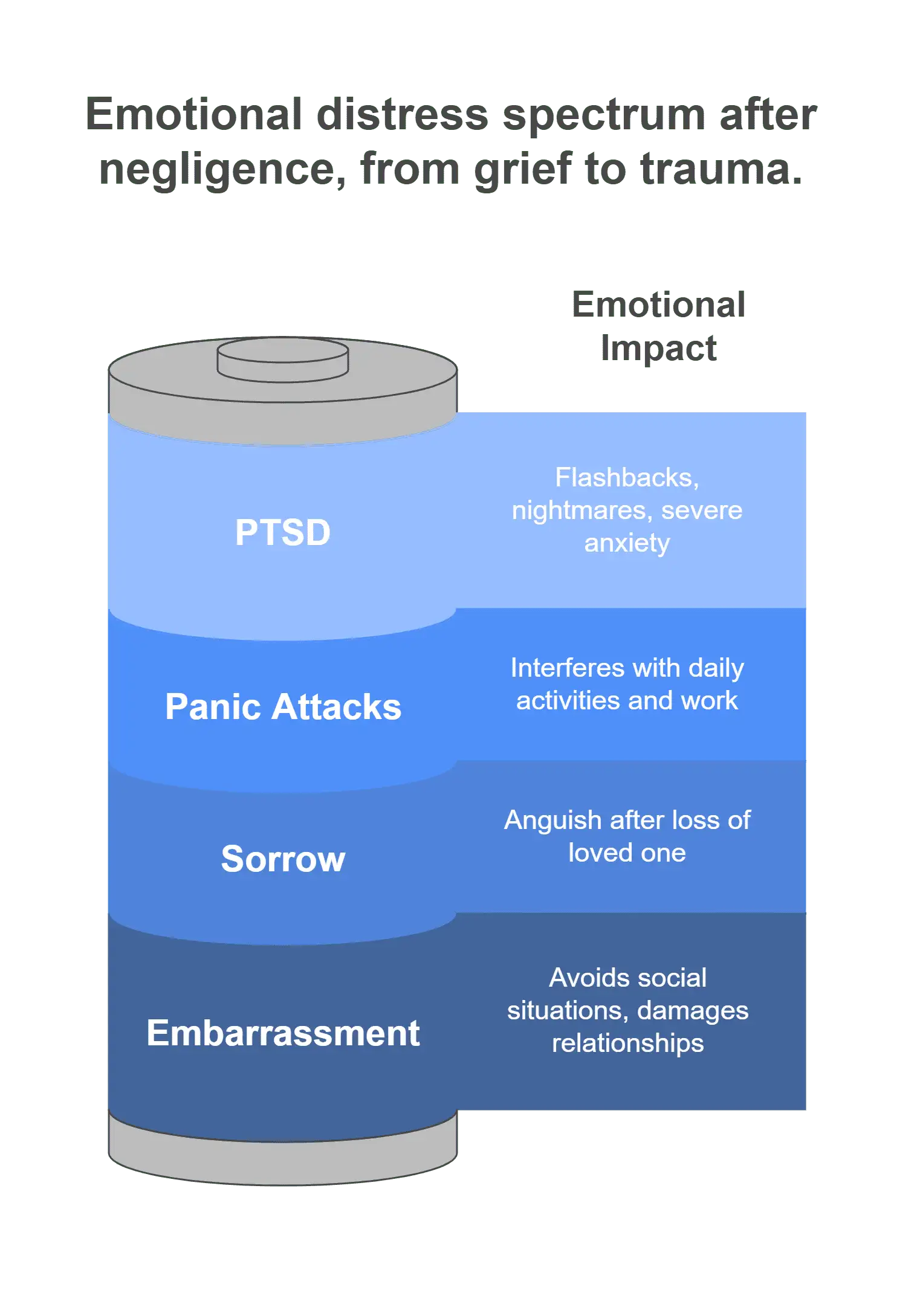
- PTSD or trauma-related disorders that trigger flashbacks, nightmares, or severe anxiety after an accident or a traumatic workplace incident.
- Anxiety and panic attacks that interfere with daily activities, work performance, or the ability to engage in previously enjoyable activities.
- Depression leading to social withdrawal, loss of interest in activities, sleep disturbances, or changes in appetite and energy levels.
- Humiliation or embarrassment from workplace harassment or discrimination that damages personal and professional relationships.
- Grief, sorrow, or mental anguish following the death or serious injury of a loved one due to another’s negligence.
💡 These aren’t hypothetical symptoms – they represent real suffering that California courts recognize as compensable when it stems from a personal injury or an employment violation.
Common scenarios of suing someone for emotional distress
Knowing real-world applications of emotional distress claims can help clarify how these cases work in practice. Here are two hypothetical scenarios illustrating different types of emotional distress claims in California, one rooted in a personal injury and one in the workplace.
Hypothetical Scenario #1:
A mother was picking up her child from school when she witnessed a distracted driver strike her 8-year-old son in the crosswalk. Though her son survived with moderate injuries, the mother developed severe anxiety, insomnia, and recurring nightmares. She required extensive therapy and medication to manage her symptoms.
Under California’s “bystander” theory of negligent infliction of emotional distress, she could recover damages for her psychological trauma because she was present at the scene, closely related to the victim, and suffered serious emotional distress as a result. This is a personal injury claim.
Hypothetical Scenario #2:
An employee endured months of deliberate, extreme harassment at work after reporting safety violations. A supervisor repeatedly screamed profanities at her in front of coworkers, mocked her disability, and threatened to fire her daily. She developed depression and panic attacks and needed medical leave to cope.
This could support an intentional infliction of emotional distress claim brought alongside a workplace harassment and retaliation case under California’s Fair Employment and Housing Act, because the conduct was extreme, outrageous, and tied to unlawful employment practices.
A recent case from Feher Law resulted in a $4 million verdict for a client who suffered PTSD and a concussion in an auto crash (Flores vs. M&N Rug Enterprise, LLC). While physical injuries were present, a significant portion of the compensation addressed the psychological trauma that prevented the client from returning to normal activities for over a year.
How much can I sue for emotional distress in California?
California does not impose a specific cap on emotional distress damages in most personal injury cases, nor in FEHA employment cases brought under Government Code 12940. The amount you can recover depends on several factors, including the severity of your emotional distress, the impact on your daily life, and the strength of your supporting evidence.
For medical malpractice cases, Civil Code 3333.2 limits non-economic damages. The cap began at $350,000 for cases filed from January 1, 2023 and rises by $40,000 every January 1, reaching $750,000 in 2033. In 2026 it stands at $470,000 for a non-death claim and $650,000 in a wrongful death case. However, this cap doesn’t apply to most other personal injury claims, or to employment claims, where emotional distress is a factor.
💡 Jurors evaluate the credibility of emotional distress claims based on consistency between your testimony, medical records, and expert witness statements. Cases with thorough mental health documentation and expert testimony from respected professionals typically receive higher damage awards.
Clients who maintain consistent therapeutic relationships and document how emotional distress impacts their daily functioning often secure more substantial compensation, as this creates a compelling narrative of genuine suffering.
Emotional distress is often a major component in personal injury claims, especially in cases involving severe trauma, such as a motorcycle accident pain and suffering settlement, where victims frequently experience PTSD, anxiety, or depression alongside physical injuries. In employment cases, the same distress flows from an employer’s harassment, discrimination, retaliation, or wrongful termination.
For a full breakdown of how much you can sue for by case type, defendant, and severity, including what landlords, schools, HOAs, and employers typically pay, see our complete guide to suing for emotional distress in California.
Our Torrance personal injury lawyer will provide a personalized assessment of your potential compensation during a free consultation.

How to calculate emotional distress damages in California
Valuing emotional suffering that is part of a personal injury or employment claim requires a systematic approach that accounts for both subjective experiences and objective evidence. The process involves multiple considerations to arrive at a fair compensation amount.
- Assess the severity and duration of your emotional harm through clinical diagnoses, treatment plans, and prognosis for recovery.
- Evaluate all documented therapy sessions, psychiatric care, and medication requirements as tangible evidence of your suffering.
- Measure impact on quality of life by documenting changes in sleeping patterns, relationships, work performance, and daily activities.
- Factor in whether your condition is likely temporary or permanent, as chronic conditions typically warrant higher compensation.
- Apply appropriate calculation methods, which may include the “multiplier method” or “per diem” approach, depending on your specific circumstances.
Below is a general framework for how multipliers might be applied to the emotional distress portion of a personal injury or employment case:
| Impact Level | Symptoms | Documentation | Typical Multiplier Range |
|---|---|---|---|
| Mild | Temporary anxiety, minor sleep disturbances | Limited medical visits | 1.5-3x economic damages |
| Moderate | Depression, panic attacks, therapy needed | Regular treatment, medication | 3-4x economic damages |
| Severe | PTSD, major depression, hospitalization | Extensive treatment, expert testimony | 4-5x economic damages |
| Catastrophic | Suicidal ideation, inability to function | Inpatient care, permanent impairment | 5-10x economic damages |
The more comprehensively your mental health records document your trauma, the stronger position you’ll be in when negotiating a settlement or presenting your case to a jury.

Estimate your potential emotional distress damages
Our pain and suffering calculator provides a helpful starting point for knowing the possible value of emotional distress that stems from an accident, injury, or workplace violation. This free tool helps estimate compensation for psychological trauma, including PTSD, depression, anxiety, and grief resulting from another’s negligence in a personal injury, or from an employer’s unlawful conduct.
The calculator considers several factors:
- The severity of your emotional suffering
- Duration of your symptoms
- Impact on daily activities
- Related medical and therapy expenses
- Any physical injuries accompanying the emotional trauma
✔️ Our calculator is specifically designed to address emotional distress damages in California, not just physical injuries. The psychological impact of a serious accident or unlawful workplace conduct deserves proper compensation under the law.
Your compensation estimate may change significantly based on factors like comparative negligence. If you were partially responsible for the incident, your recovery could be reduced proportionally – our calculator helps visualize these potential scenarios.
Our Huntington Beach personal injury lawyer is available for a free consultation to provide more tailored guidance based on the specific details of your situation.
We understand you might not be ready to speak with someone immediately. If your emotional distress is connected to an accident, an injury, or workplace misconduct, please fill out the form below and we’ll contact you as soon as possible. Time is of the essence in these claims.
"*" indicates required fields
Emotional distress statute of limitations in California
When your emotional distress arises from a personal injury, you generally have two years from the date of the incident to file under California Code of Civil Procedure 335.1. This timeline applies whether your claim involves negligent infliction of emotional distress or intentional infliction of emotional distress tied to a PI accident.
When your emotional distress arises from an employment violation, a different deadline applies. Employment-based emotional distress is pursued under FEHA, which first requires filing an administrative complaint with the California Civil Rights Department within 3 years under Government Code 12960 and then suing within 1 year of the right-to-sue notice under Government Code 12965. Because the FEHA process and the personal injury statute operate separately, identifying which path your claim falls under early is critical.
If you wait too long to file, you may permanently lose your right to pursue compensation, even if you have compelling evidence of severe emotional suffering.
Several exceptions can extend or “toll” these deadlines in specific circumstances. For minors, the statute doesn’t begin until they turn 18. The “discovery rule” may apply when emotional harm isn’t immediately apparent. Cases involving government entities require filing an administrative claim within six months.
Pursuing emotional damages in a wrongful death claim
Family members who have lost a loved one due to another’s negligence or wrongful actions can pursue compensation for the emotional suffering caused by this loss. California law allows certain relatives to recover both economic and non-economic damages through wrongful death claims.
Recoverable emotional damages may include loss of love, companionship, comfort, care, assistance, protection, affection, society, and moral support. The relationship to the deceased significantly impacts the potential recovery, with spouses, children, and parents typically having the strongest claims.
⚠️ Even if you weren’t financially dependent on the deceased, you may still recover significant emotional distress damages based on the quality and closeness of your relationship.
California Code of Civil Procedure §§377.60–377.62 establishes who can file a wrongful death claim and what damages are recoverable.
Need expert legal advice on a lawsuit for emotional distress?
Filing an emotional distress claim requires specialized knowledge of California personal injury and employment law and strategic documentation of your suffering. Our team has extensive experience helping clients recover damages for emotional distress that stems from a car accident, a serious personal injury, or workplace harassment, discrimination, or wrongful termination.
We understand the challenges in proving the severity of emotional distress and can connect you with qualified mental health experts to strengthen your claim. Our attorneys will guide you through every step of the legal process, from initial consultation through settlement negotiations or trial if necessary.
What to Expect When You Work With Feher Law
- Free Consultation: We review your situation at no cost and no obligation. We identify whether your emotional distress arises from a personal injury accident or an employment violation, explain the elements of that claim, how California courts value emotional distress, and what your case may realistically be worth.
- Evidence and Documentation: We work with you to gather medical records, therapy notes, psychiatric evaluations, and expert witness testimony that establishes the severity of your emotional suffering and ties it directly to the underlying accident, injury, or workplace conduct.
- Claim Strategy: We determine whether your case involves negligent or intentional infliction of emotional distress, whether it is pursued as a personal injury or a FEHA employment claim, identify all liable parties, and develop the strongest legal approach to maximize your compensation.
- Negotiation: We handle all communications with insurance companies, employers, and opposing counsel, presenting a complete demand that accounts for emotional distress damages, related medical costs, and punitive damages where applicable.
- Trial-Ready Representation: If a fair settlement isn’t offered, we take your case to court. Our attorneys have 45+ combined trial years. You pay nothing unless we win.
Contact us online or call today at (310) 340-1112 for a free, confidential consultation about your emotional distress case.
Notable Recent Settlements
Examples of California cases Feher Law has resolved on behalf of clients in this practice area:
- $1.4M – Wrongful Termination
- $933K – Wrongful Termination
- $750K – Wrongful Termination – Disability Discrimination
- $450K – Wrongful Termination
Past results do not guarantee future outcomes. Every case is evaluated on its specific facts under California law.
Estimate your case value: Use our free Discrimination Lawsuit Settlement Calculator for a quick estimate of what your case could be worth, or speak directly with a Torrance employment lawyer for a personalized review.
Last reviewed by Thomas Feher, Esq. – September 2026
Why California Clients Choose Feher Law
Super Lawyers 2022-2026 | Avvo 10.0 Superb | Gerry Spence Trial Lawyers College Graduate

Frequently Asked Questions
Do I need a diagnosis to file an emotional distress claim?
While not absolutely required, having a formal diagnosis from a licensed mental health professional significantly strengthens your emotional distress claim in California. Documentation of conditions like anxiety, depression, or PTSD provides objective evidence of your suffering and helps establish the severity of your emotional distress due to the incident.
What if I've never seen a therapist - can I still sue?
Yes, you can still pursue an emotional distress claim without prior therapy, though it creates additional challenges. Your case will rely more heavily on testimony from friends, family, and coworkers who can verify changes in your behavior and emotional state. Starting therapy after the incident can help document the impact of emotional trauma.
Will my case be stronger if I also have physical injuries?
Generally, yes. Cases combining physical injuries with emotional distress typically have a clearer path to compensation since the psychological impact becomes more demonstrable. However, California law recognizes the severe emotional distress that can occur even without physical harm, particularly in cases of intentional infliction of emotional distress.
How long do emotional distress lawsuits usually take to settle?
The timeline for emotional distress claims varies widely, typically ranging from 6-24 months. Simple cases with clear liability and well-documented emotional suffering may settle within 6-12 months. Complex cases involving serious emotional trauma or disputed liability often take 12-24 months or longer, especially if they proceed to trial.
Can I sue my employer for emotional distress in California?
Yes. If your emotional distress was caused by workplace harassment, discrimination, retaliation, or wrongful termination, you can file an emotional distress claim against your employer. California’s Fair Employment and Housing Act (FEHA) allows employees to recover damages for emotional harm caused by unlawful employer conduct, including compensation for anxiety, depression, and PTSD, alongside lost wages and other economic damages.
What evidence do I need to prove emotional distress in California?
Strong evidence typically includes medical records and therapy notes documenting your diagnosis and treatment, expert testimony from a licensed mental health professional, personal journals or diaries showing the day-to-day impact of your condition, witness statements from people who observed changes in your behavior, and records showing how the distress affected your work performance or relationships. The more consistent and well-documented your evidence, the stronger your claim will be.
Can I file a lawsuit just for emotional distress in California?
Yes, but in practice emotional distress is almost always pursued as part of an underlying personal injury or employment claim, not as a freestanding case for ordinary upset. The two paths are Negligent Infliction of Emotional Distress (NIED), tied to a personal injury accident and requiring either a physical impact or witnessing a close family member’s injury under Thing v. La Chusa, and Intentional Infliction of Emotional Distress (IIED), which requires extreme and outrageous conduct, intent or reckless disregard, and severe distress, often arising from workplace harassment or other intentional misconduct.
How much are emotional distress lawsuits worth?
CA emotional distress cases typically settle $25,000 to $250,000 when supported by therapy records, medication, and diagnosis. Severe cases involving PTSD, hospitalization, or 7-figure underlying conduct (sexual assault, hate crimes) can exceed $1 million.
What is the statute of limitations for emotional distress in CA?
2 years under CCP 335.1 when distress arises from a personal injury or tortious conduct. Claims tied to employment must use FEHA timelines: 3 years to CRD, then 1 year after right-to-sue. Government defendants require a tort claim within 6 months under Government Code section 911.2.
What is a garden-variety emotional distress claim worth without treatment?
Strong cases include treatment from a licensed therapist, psychiatrist, or physician. CA juries rarely award substantial emotional distress damages without records showing the plaintiff sought help. Garden-variety claims (no treatment) typically cap at $25,000 to $50,000.
Does workers' compensation block an emotional distress claim against my employer?
Often only through FEHA harassment/discrimination claims, because workers’ comp exclusivity under Labor Code section 3600, which makes compensation the employer’s liability in lieu of any other liability whatsoever, bars most standalone IIED claims against employers. Exceptions exist for conduct outside the employment relationship, sexual assault, or violations of fundamental public policy.
Are punitive damages available?
Yes under Civil Code 3294 when the defendant acted with malice, oppression, or fraud. Punitive awards in CA IIED cases commonly equal 1x to 4x compensatory damages.
Related California injury resources: PTSD car accident settlements